
When planning an international trip, one of the first questions most travellers ask is: Should I buy an eSIM before leaving, or just pick up a local SIM card at the airport? Both options provide mobile data abroad, but they serve different needs. Let’s explore how they compare and which one makes more sense depending on your travel style.
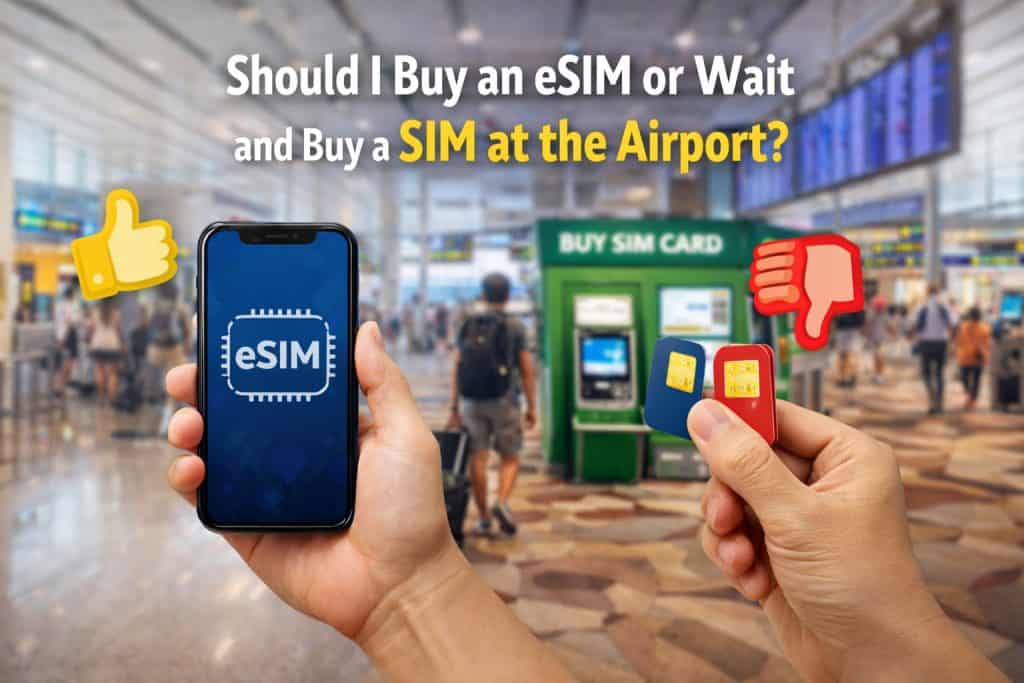
I. Buying a SIM Card at the Airport
Many travellers still choose to buy a local SIM card upon arrival.
Here’s how it usually goes:
- You find a telecom counter or kiosk after landing.
- Staff verify your identity using your passport.
- They activate a physical SIM card and set up the data plan for you.
- The process can take anywhere from 15 to 30 minutes.
Advantages
- In-person assistance from local staff.
- Includes call and SMS options, which some eSIMs don’t offer.
- Reasonable rates for long stays in one country.
Disadvantages
- Waiting in line after a long flight.
- Counters might be closed during late arrivals.
- Risk of losing your home SIM when swapping cards.
- Each new country requires a new card, costing extra time and money.
If you’re visiting only one country for several weeks, an airport SIM is fine. Otherwise, there’s now a simpler, faster alternative — the eSIM.
II. What Is an eSIM and How It Works
An eSIM (embedded SIM) is a digital version of a SIM card that’s already built into your phone. There’s nothing to insert or remove. You simply purchase a plan online, receive a QR code, and activate it in your phone’s settings.
The eSIM starts working the moment your phone connects to the network — no lines, no paperwork.
Why Travellers Prefer eSIM
- Instant activation before or after your flight.
- Work across multiple countries in one plan.
- No physical SIM card to lose.
- Predictable pricing without roaming fees.
- Eco-friendly and fully digital.
This option is ideal for travellers who value convenience and flexibility or for those visiting several Southeast Asian destinations within one trip.
III. eSIM vs Airport SIM: A Practical Comparison
| Feature | Airport SIM | eSIM |
| Setup | 15–30 minutes after landing | 3–5 minutes before departure |
| Coverage | Usually one country | Often multi-country regional coverage |
| Cost | Slightly cheaper for long-term stays | Very similar average rates |
| Flexibility | Requires SIM swap | Switch plans in settings instantly |
| Roaming Fees | May apply | Typically none |
| Convenience | Must visit counter | Fully online process |
► Conclusion
- If your journey covers multiple countries or short stays, choose an eSIM.
- If you’ll remain in one place for a long visit and need local calls, a physical SIM might still work better.
IV. The Smart Time to Buy an eSIM
Buying your eSIM before departure ensures you have internet access immediately upon landing. You’ll appreciate this especially if:
- You arrive late at night when kiosks are closed.
- You want instant access to navigation and ride apps.
- You’re crossing multiple borders during one trip.
At this stage, travellers usually start searching for trusted providers. A practical option is Malaysia eSIM — a platform offering regional eSIM plans for Southeast Asia. You can purchase your plan online, receive the QR code instantly by email, and activate it in just a few minutes before your flight.
V. When an Airport SIM Still Makes Sense
Choosing a physical SIM can still be the right move if:
- You’re staying in one country for over a month.
- You need local calling or texting functions.
- Your phone does not yet support eSIM technology.
- You prefer speaking directly with local staff for guidance.
VI. Setup Tips for First-Time eSIM Users
To ensure a smooth experience:
- Verify your phone supports eSIM (most new models do).
- Install and test it while connected to Wi-Fi before flying.
- Save your QR email in multiple places.
- Turn on “Mobile Data” and “Roaming” once you land.
- Don’t delete the eSIM profile until your trip ends.
VII. Final Thoughts
Both methods connect you to mobile data abroad, but your priorities determine which is best.
If you favour convenience, quick setup, and reliable connection across countries, buying an eSIM before your trip is the better long-term choice.
A well-selected eSIM plan saves time and helps you start your journey online from the moment you arrive.